Portfolio News

Turning Local Reports Into Action: How Map Action Is Transforming Environmental Response in Mali

Kaicedra Consulting Group Data Science+AI Mali
Jul 23 , 2025
Student submits environmental incident via Map Action
On this page

Data Science+AI

Kaicedra Consulting Group

Mali
Amount invested $99,300 USD Funding Status active early period Founded in 2017 by Boubacar Keita

Mali is ranked 160 out of 180 on the Environmental Performance Index (2024), and 70% of its population – nearly half of which are children – are exposed to daily environmental risks. This puts youth on the frontlines of exposure to environmental hazards – without the tools or systems to report or respond. Moreover, local governments and communities lack access to timely, accurate environmental data, leading to delayed responses, misallocated resources and worsening conditions. 

That’s where Map Action, a recent graduate of the UNICEF Venture Fund's Climate Action Cohort, steps in. 

This civic tech startup, founded in Mali, is reimagining how environmental information flows – bridging the gap between citizen experience and government action. Using a mobile app powered by AI and geolocation, Map Action enables people to report issues like illegal dumping, flooding, or blocked drainage channels – even offline. These reports are instantly transformed into actionable data for local and national institutions, helping them respond faster, smarter, and more transparently. 

Map Action Description
Map Action

The Roots: Prototyping With Purpose

Map Action’s early work focused on Mali’s most urgent urban challenges—especially in sanitation and WASH (water, sanitation, and hygiene). Their first prototype was a simple Android app where citizens could submit reports with a photo, GPS location, and short description. On the government side, a web dashboard visualized reports on a map, ready to inform interventions. 

At the time, we believed this would be enough: a simple, intuitive system where citizens report, and institutions act,” said CEO Boubacar Youssef Keita. 

But the team quickly learned otherwise. Early pilots revealed that even basic digital tools weren’t intuitive for many government users. Institutions needed hands-on training, support, and more contextual design. This realization led to a complete redesign of the platform—and a deeper commitment to capacity building alongside technology deployment. 

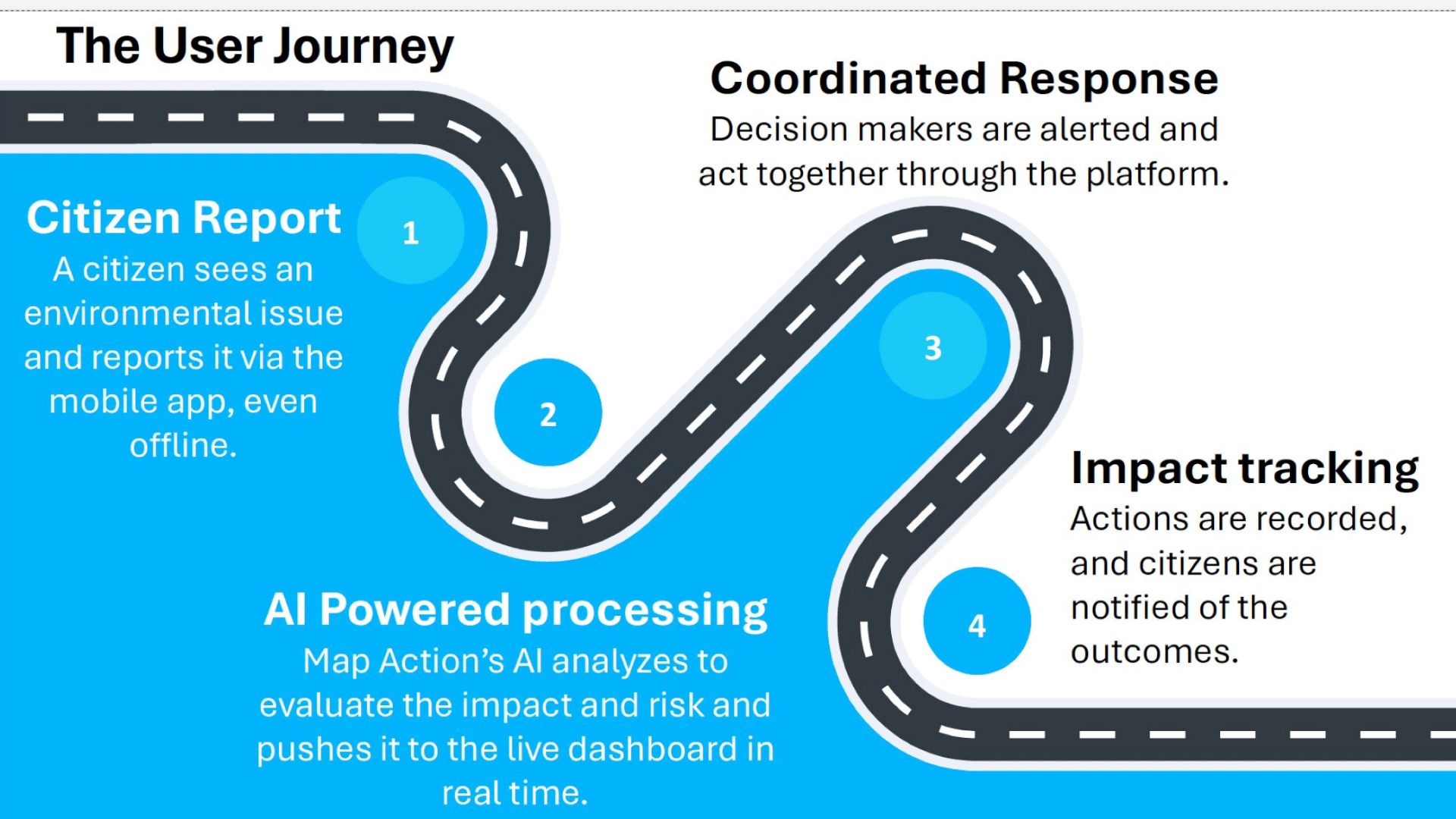
Map Action user journey explained
Map Action

Evolving With the Community

As the platform evolved, Map Action began testing updates with real users. In one field trial, 60 students and young researchers used the beta app to report environmental problems in their neighborhoods. The response was immediate – reports poured in, complete with photos and locations. But the real impact was in the streets, where people started conversations, debated causes, and proposed local solutions. 

One moment stood out: a local municipal officer participating in the test remarked: "For the first time, I can actually see where the problems are before someone calls to complain. This is what we’ve been missing. 

This grassroots energy underscored a critical insight: engagement builds trust, and trust fuels action. That’s why Map Action added two-way features like real-time notifications and report tracking so users wouldn’t just submit issues, but also see what happened next. 

To increase accessibility, the team is looking to integrate voice input and local language support using Natural Language Processing (NLP) in the future, ensuring even non-literate users can participate meaningfully in the future.  

For the first time, I can actually see where the problems are before someone calls to complain. This is what we’ve been missing.
Map Action user when testing the platform
Student submits environmental incident via Map Action
Map Action

Building Smarter Tools for Institutions

Map Action also deepened its collaboration with institutional partners. With support from GIZ’s Mali Sanya program and the national environmental agency Direction Nationale de l'Assainissement du Contrôle des Pollutions et des Nuisances (DNACPN), the team embedded the platform into real-world government workflows. 

They introduced machine learning to automatically classify reports and satellite imagery to contextualize them. This dramatically sped up analysis from days or weeks to just hours. For government teams, this meant better prioritization and faster intervention planning. 

Each version of Map Action has been shaped by hands-on feedback and real user experience. What started as a simple reporting tool is now an AI-enhanced geospatial intelligence platform, said Keita. 

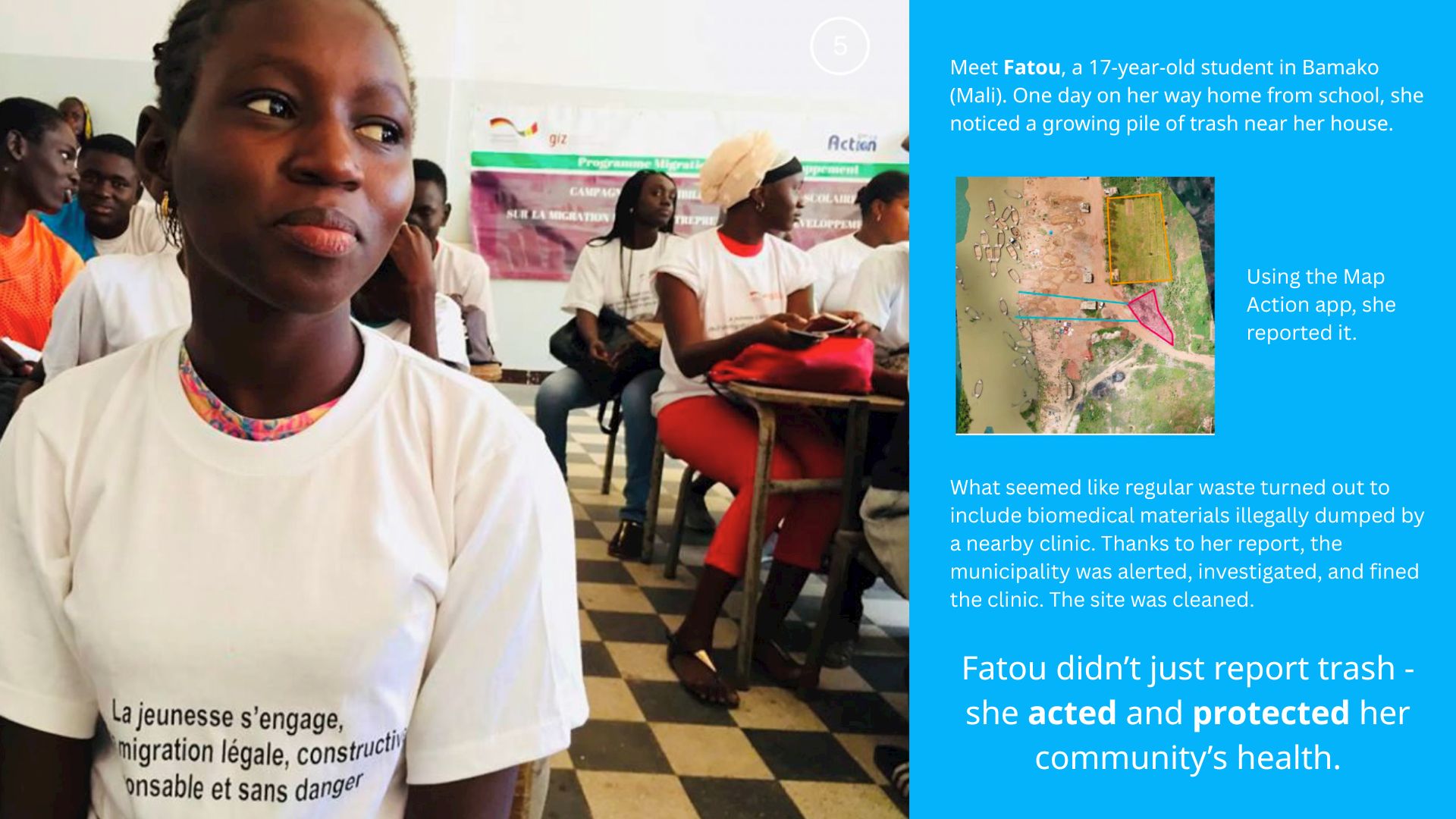
One real-world example of this impact is when a 17-year-old named Fatou used the app to report a trash pile near her home in Bamako. What seemed like regular garbage turned out to contain illegally dumped biomedical waste from a nearby clinic. Thanks to her report, the authorities investigated, fined the clinic, and cleaned the site—protecting her community’s health. 

Impact story of Mali youth taking action to protect her community's health by reporting an environmental incident via Map Action
Map Action

From Tech to Service: A New Business Model

Initially funded by grants, Map Action believed data alone would drive change. But as they worked more closely with public institutions, they realized that data is just the beginning. Many agencies lacked the capacity or systems to act on what they saw. What they needed was training, guidance, and operational support. 

This led to a new hybrid business model: 

  • Free for citizens to report issues
  • Premium services for institutions that include advanced analytics, tailored reports, training, and ongoing support 

Their first two paying clients validated this approach, proving that a civic tech solution could also be a sustainable service model.

 
Map Action is no longer just a platform—it’s a service layer that supports real decision-making,” said Keita. 

What’s Next?

In the coming year, Map Action is focused on scaling both within Mali and across the region. 

In Mali, the team is preparing to pilot its platform in humanitarian settings for the first time, in collaboration with UNICEF Mali. This initiative will help monitor WASH conditions in real time inside refugee camps—testing the platform’s adaptability in high-stress environments. 

Regionally, Map Action is planning new pilots in Senegal and Côte d’Ivoire, expanding the system beyond sanitation to broader environmental and health monitoring. 

Scaling, however, brings new challenges: working with public institutions requires patience, long lead times, and careful adaptation to local governance structures. Readiness programs—training, onboarding, and change management—are becoming essential to success. 

To scale responsibly, we need to stay agile—both technically and strategically—without compromising the integrity of our solution.
Boubacar Youssef Keita, CEO of Map Action

How Others Can Support

Map Action is building a coalition to drive systemic change across West Africa. They’re seeking collaborators across sectors: 

  • Governments (e.g., sanitation, urban planning, environment ministries in Senegal, Côte d’Ivoire) 
  • Development banks, especially the African Development Bank 
  • NGOs and humanitarian actors, such as UNICEF, UNDP, Oxfam, and AFR’EAU 
  • Academic and civic tech communities, to support open-source development and build local talent pipelines 

These partnerships are not just about using the tool—they’re about co-owning a mission to build more responsive and resilient communities. 

Map Action Overview
Map Action

A Boost from UNICEF Venture Fund

Map Action’s growth has been supported by the UNICEF Venture Fund, which provided not just capital, but credibility and exposure. 

“The Fund gave us visibility at the right moments—in front of the right partners,” said Keita. 

One key moment was Map Action’s presentation at the Spark 2.0 Global Finals in Stockholm, opening new doors globally. 

The UNICEF Mali Country Office has also played a crucial role, co-leading the national pilot and preparing the humanitarian deployment. Their hands-on engagement helped turn an innovative concept into a field-tested solution. 

Technical mentorship from the Fund helped Map Action improve documentation, build robust testing pipelines, and elevate product quality—critical elements that often go unnoticed but define long-term viability. 

Map Action isn’t just collecting environmental data. It’s building the connective tissue between citizens, institutions, and action—wherever it’s needed most. 

View of user exploring the Map Action app on their phone
Map Action

Learn more about Map Action

Map Action began its journey with UNICEF Venture Fund in November 2023 and graduated in May 2025. Read more about their journey and the power of community-sourced data in Mali. 

Interested to learn more about Map Action? Visit their website or follow on Facebook, LinkedIn, and Twitter. Get in contact with the team directly via email at [email protected] 


Share this story