Portfolio News

How UNICEF Yemen Transformed Cash Transfer Programming From Reactive to Real-time Accountability

Jun 16 , 2026
A family from Amran Governorate in Yemen shares lunch. This family used money received through the emergency cash transfer project to purchase food.
On this page

The Venture Fund country office investment in UNICEF Yemen for AI-powered anomaly detection in cash transfers ran from late 2023 to 2025. What follows is an account of what was built during that period, the outcomes, and how this provided a transformative shift in efficiency and transparency in cash transfer programming.  

A payment system built on rules—and its limits

Yemen's cash transfer programme has been running since 2017, channeling close to a billion dollars to public sector workers and humanitarian aid beneficiaries — 22 million payments totaling $980 million USD to date. The programme reaches 9.6 million people, roughly a third of Yemen's population: 1.5 million poor and vulnerable households, and over 200,000 frontline workers including teachers, doctors, and government employees. Frontline workers are paid weekly; larger cohorts of aid recipients every two to three months. 

The Yemen Service Center, established in 2017 as a dedicated unit within the UNICEF country office, manages this operation through a Management Information System that handles data storage, payment processing, monitoring, and a complaints and feedback mechanism. For years, it operated a structured, rules-based payment cycle , that usesbanks fwhich uses dwhich uses the banks for,ur which uses the banks for which uses the banks for payment, with reconciliation conducted after payment. Anomaly detection was part of this system, but it relied on algorithms developed from known risk patterns: meaning it could only flag what the team already knew to look for. Data analysts manually verified names, amounts, and IDs at each stage. 

“In this cycle of process, we saw that there were several things we were not capturing. Even if we captured them, it might be a reactive audit—something that happens after.” 

— Gianluca Buono, Senior Project Coordinator, UNICEF Yemen 

The volume and complexity of the data made deeper inspection nearly impossible within weekly payment windows. Anomalies that required pattern-matching across an individual's payment history—or cross-referencing complex Arabic names against multiple ID types—were simply beyond what manual review could reliably surface. 

A family from Amran Governorate in Yemen shares lunch. This family used money received through the emergency cash transfer project to purchase food.
UNICEF/UN0326764

What manual review couldn’t see

Three structural gaps shaped the case for an AI solution: 

Individual-level pattern detection.  Existing tools could flag global outliers—the highest amounts in a list, for instance—but had no mechanism for detecting whether a particular payment was anomalous relative to that person's history. A beneficiary who normally receives a modest weekly payment might receive a much larger sum the following week without triggering any alert, because the amount wasn't unusual for the population overall. 

Arabic language complexity.  Arabic names in Yemen often contain four or five components: a given name, a father's name, a grandfather's name, and sometimes more. Diacritics matter. Spellings vary. Existing natural language processing tools were not equipped for this: Arabic remains under-resourced in AI development compared to English or Chinese. Standard models simply couldn't do the job. 

Data infrastructure.  Before anomaly detection could be built, significant foundational work was required: documenting existing data structures, building a data warehouse, and constructing a data lakehouse that could feed the AI continuously rather than in batches. This groundwork consumed a substantial portion of the first phase of the investment—and is a prerequisite any future implementer should anticipate. 

The Yemen team spent significant time on data documentation, and warehouse architecture, and setup before any AI modelling could begin. “There’s no way you can do AI without data,” Joseph noted. “We spent a lot of time trying to create specific databases for the AI.” 

Om Amat Al Rahman while she is receiving the money provided to her by the Cash for Nutrition Program.
UNICEF/UN0649833

Seven metrics, built from evidence and real pain points

The anomaly detection framework was not designed in the abstract and was built iteratively from issues the team had actually observed in the payment data. As Joseph put it: “These are evidence-based issues that we see. We get these issues and we add them to the AI system.” 

The framework currently checks seven categories of anomaly. Every flag is reviewed by a human analyst before any action is taken. The framework started with fewer metrics and has expanded as new patterns emerged during operation. 
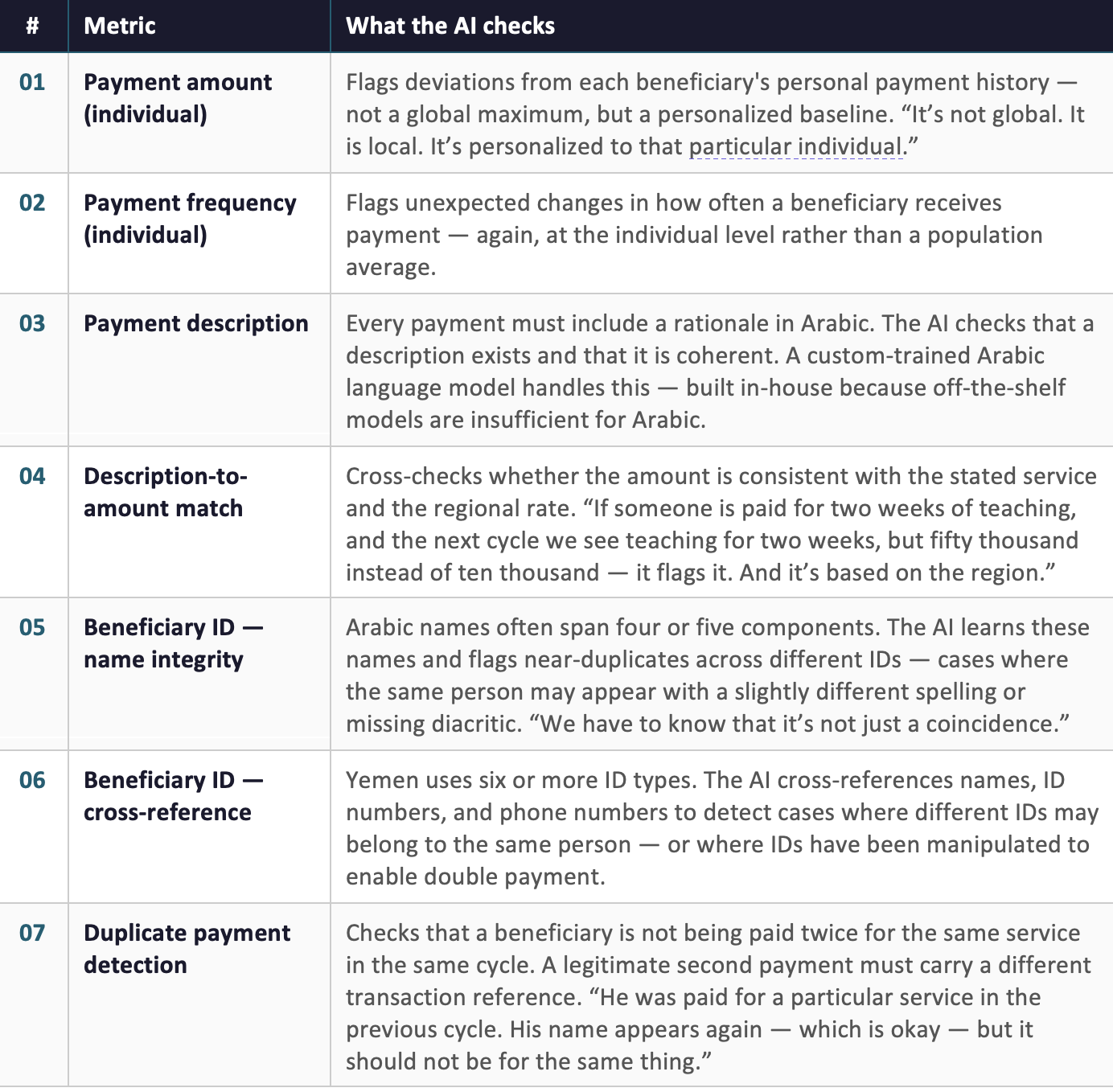
What makes this different

Three technical features distinguish this system from other approaches. 

Explainable AI.  For every flagged anomaly, the system generates a traceable explanation— not a generic error code, but a specific reason mapped back to the features in the underlying data. “For every anomaly, there’s a complete explanation of how you can trace it,” Joseph said. “You can go back to that particular record. What the AI is saying is exactly what I can see from the database.” The team noted that explainability of this kind is absent from other humanitarian AI systems they were aware of. 

A custom Arabic language model.  Because existing large language models are not adequately trained for Arabic, particularly in the specific vocabulary and naming conventions of Yemen’s payment environment, the team trained their own model using reinforcement learning. “We trained our own Arabic model because we can’t depend on off-the-shelf tools.” Joseph says. “We trained it to understand the context.” 

Human-in-the-loop governance.  No payment is blocked or modified by the AI alone. Every flag is reviewed by a data analyst. If the flag is accepted, it is escalated back to the Yemen team for correction before going to the financial service provider. If it is overridden, a note is logged — creating an audit trail for every exception. “There’s always a note before we can send it to the financial service provider. That’s data governance.” 

Efficiency and accountability, not a silver bullet

It would be tempting to frame this system primarily as a fraud-prevention tool, and it does contribute to fraud prevention. But the team find that the real value add and fundamental shift here is auditability before the fact.   

Previously, irregularities could only be surfaced through post-payment audits, by which time the payment had already been made, the window had moved on, and correction was significantly harder. Now, the review happens before funds leave the system, with a documented exception trail for every flag. For a programme disbursing $200–250 million per year, this represents a meaningful improvement in fiduciary transparency. 

The efficiency gain is equally significant. Anomaly review that previously occupied a full analyst workday now takes fifteen minutes—without compromising accuracy, and arguably improving it. In a weekly payment cycle with thousands of transactions, that time saving is substantive. 

“The value add here isn’t so much how much of donor funding you save by decreasing transaction fees and payment to intermediaries,” Joseph reflected, “as being able to reach a level of auditability that doesn’t take so much time after the transfer has been made. If we strengthen that part of data integrity, we are sure going to have a more reliable program.” 

“What you’d spend the whole day doing, you can do in fifteen minutes with AI. No payment is made without going through the system.” 

Joseph Emeka Agbamoro, Technical AI Specialist, UNICEF Yemeny, Yemen Service Center 

What’s next: institutional integration and AI-assisted grievance handling

The current Complaint and Feedback Mechanism (CFM) receives thousands of calls after each payment cycle, more than staff can handle, leading to lost complaints and response delays of days to weeks. A proposed AI call assistant would log complaints, auto-resolve straightforward cases, and route complex ones to human agents. “Some of those calls are lost. We want to take a big step to have an AI support,” Joseph says. 

The AI for CFM phase is still in early design, with use cases defined but implementation details to be confirmed. The anomaly detection system itself continues to evolve: the team began with fewer than seven metrics and has added new ones as patterns emerge.  

The Yemen country office experience offers a replicable template for how AI can be integrated into humanitarian cash programming—not as a replacement for human judgment, but as infrastructure for accountability. The groundwork is demanding: data documentation, warehouse architecture, and custom model training are definitely prerequisites. But for programmes of this scale and complexity, the shift from reactive audits to real-time, pre-disbursement review represents exactly the kind of systemic improvement that AI, applied carefully, is well-positioned to deliver. 

Share this story
Stories by this author

Why Open Source: UNICEF Ventures' Approach to Developing Sustainable Software

Read Story
Jenina Alli
Innovation Specialist