Portfolio News

Building trust in information, one verification at a time from Mali

AGENTSIA Data Science+AI Mali
Jun 09 , 2026
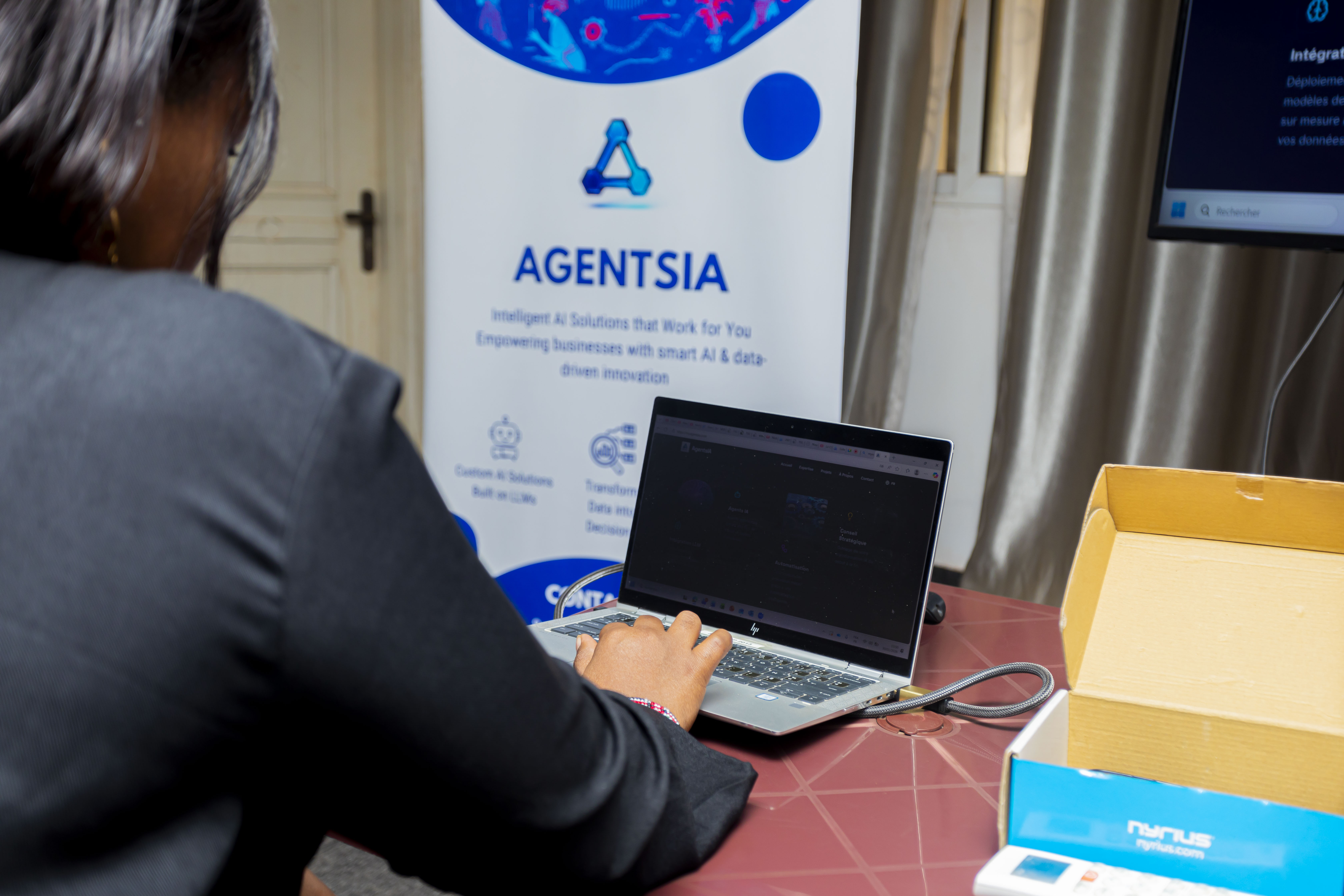
AGENTSIA banner in the background
On this page

Data Science+AI

AGENTSIA

Mali
Amount invested $29,950 USD Funding Status active early period Founded in 2025 by Ramata n'Diaye & Mohamed Doumbia
Female Founded

Introducing AgentsIA Mali and CHECK IA

In Mali, checking whether a piece of information is true is harder than it sounds. Even for the professionals whose job it is — journalists, fact-checkers, researchers — verifying a single claim can mean hours of searching, cross-referencing and translating, often across languages and sources that no single tool brings together. For everyone else, there is rarely any practical way to check at all.

CHECK IA is our answer to that problem. It is a simple online tool: you paste a piece of text or upload an image, and within a few seconds it tells you what credible sources say about it, where that information comes from, and whether the claim holds up. Today it verifies text and images; voice messages and video are on our research roadmap, prompted directly by what early testers told us they needed.

We are starting with the people who fight misinformation professionally and expanding toward the wider public from there. Local Malian news is our entry point — the rumours, manipulated images and false reports that circulate day to day — and from that base the tool extends to the broader categories of misinformation that do the most damage, including health and elections.

AgentsIA Mali, the company behind CHECK IA, was founded in Bamako in 2024. We are building the first fact-checking platform designed from the ground up for Francophone Africa — one that works in French today, is being extended to Bambara, and is built for the connectivity realities of the Sahel.

The problem we are tackling

The way information reaches people in Mali has changed faster than the tools to make sense of it. Nearly everyone has a phone — mobile connections are equivalent to around 94 percent of the population — yet only about 35 percent of people actually use the internet (DataReportal, 2025). The people who are online receive and share a constant stream of content, much of it impossible to verify, and they do so largely on mobile, often over slow or intermittent connections.

This is not a minor inconvenience. False health information circulates during disease outbreaks. Election rumours inflame political tensions. Manipulated images travel faster than corrections. In a region already navigating significant instability, the cost of misinformation is measured in trust eroded, decisions made on false premises, and communities pulled apart.

There is also a language gap that global tools simply do not address. Bambara is spoken by around 14 million people and is understood by roughly 80 percent of Mali's population as a first or second language. Since 2023, French is no longer Mali's official language — it has been replaced by Bambara and twelve other national languages, with French kept only as a working language. A large share of the population engages with information primarily in Bambara, yet almost every fact-checking tool available today works only in English or standard French. For those users, the existing solutions are effectively out of reach.

Existing fact-checking organisations do important and credible work, but they operate manually and reach only a small fraction of the population. Global verification tools, meanwhile, were built for other contexts and do not reflect local languages, local media sources, or the specific patterns of misinformation that circulate in the Sahel. That is the gap CHECK IA is built to close.

When the adults around children can verify what they read online, better decisions follow for families, classrooms and communities.
AGENTSIA

Why we use AI

Manual fact-checking is slow by nature. A journalist verifying a single viral claim might spend hours searching, cross-referencing and translating. AI compresses that process into seconds — not to replace human judgment, but to give people the information they need to exercise it.

The scale argument matters just as much. A human team can verify dozens of claims a day. A well-designed AI system can handle thousands at once, spot emerging patterns, and surface credible sources in real time. In a region where the volume of circulating misinformation far outpaces the capacity of any newsroom, that scale is not a luxury — it is the whole point.

CHECK IA combines a reasoning model, a classifier trained to recognise misinformation, and tools that cross-reference claims against trusted sources. The system always shows its work: every result includes the sources it consulted and the reasoning behind its verdict. The human always has the final word.

What makes CHECK IA different

Several fact-checking tools exist globally. CHECK IA is not trying to be a better version of them — it is trying to be something they are not: a tool built with this region in mind, not adapted for it afterwards. Three things set it apart.

  • Language. CHECK IA works in French today, with Bambara as the next milestone. This is not a translation layer added on top of an English tool. It requires training data, linguistic expertise and a deep understanding of how information circulates across oral and digital channels in these languages.
  • Context. During our February 2026 session with 13 journalists, bloggers and fact-checkers at BenBere in Bamako, participants made it clear that a tool calibrated to international or Western news will miss the nuances of local political narratives. They also raised something more fundamental: in the current Malian context, official government sources are not universally trusted as a reference for credibility. CHECK IA is designed to reflect that reality, drawing on independent local media and recognised fact-checking organisations rather than defaulting to institutional channels.
  • Accessibility. The platform is built mobile-first, optimised for low-bandwidth environments, with a simple interface that does not assume digital fluency. Of the 13 professionals who tested it in February, 10 rated it easy or intuitive to use on their very first session.
Workshop participants
Check-IA responds to a real need in my work. It is innovative and practical for accessing sources quickly.
Participant, BenBere session, Bamako, February 2026

Why being open source makes the solution stronger

Open source is not just a licensing choice. For a tool that asks people to trust its verdicts on information, transparency about how it works is a basic requirement.

When the code is publicly available, communities can audit the system, researchers can study its limits, and developers across Africa can improve it, extend it for other languages, or adapt it to specific local contexts without depending on our team or our roadmap. An open architecture also means the tool can outlast any single organisation that builds it — which matters if the goal is long-term impact, not a product cycle.

Our repository is already public on GitHub. With support from the UNICEF Venture Fund, we will formalise our open-source licensing and actively build the contributor community around it, starting with developers in Mali and the broader Francophone African tech ecosystem.

How this started

There was no single dramatic moment. Misinformation is almost part of daily life here — so the real turning point was less an "aha" and more a reality check.

Working across youth empowerment and entrepreneurship in West Africa, we were already watching misinformation distort public health efforts, electoral information and trust between communities and institutions. Then we looked at where AI was heading and saw the load of false information we were living with only growing as these models became more capable and more accessible. That was the moment it clicked: the same technology accelerating the problem could be turned against it.

We thought about how much time journalists and fact-checkers spend gathering sources and verifying a single claim before they can publish a single confirmed fact. Fact-checking, at its core, is a process — a pipeline. With the right orchestration, we realised, that pipeline could be streamlined, built to work in our local languages, and made far more accessible. And because getting the wrong information can be deeply misleading — with real consequences for people with limited access to alternative sources — the stakes felt concrete.

AgentsIA Mali was founded to act on that. Not only against the misinformation we see today, but against what could come as AI keeps improving.

AGENTSIA team at work
AGENTSIA

Meet the team

AgentsIA is led by two co-founders with complementary backgrounds, supported by a small core team:

  • Ramata N'Diaye brings the strategic direction and the institutional experience. She holds an MSc in Entrepreneurship and Innovation from Birkbeck, University of London, and an MA in Media and Globalisation from Nottingham Trent University. Her prior work includes running programmes that reached over 2,000 young entrepreneurs across West Africa.
  • Mohamed Doumbia serves as Chief Technical Officer. He has more than ten years of experience in public policy and digital technologies, with a track record of managing complex projects at the intersection of government, youth, education and ICT in Mali.

They are joined by Ibrahima Koné, our Lead Developer, who leads the technical build of the platform.

Why diversity matters for our work

One of our two co-founders is a woman, and both are Malian. That is not a footnote — it shapes the decisions we make every day.

A tool built to serve communities works better when the people building it have lived in those communities, spoken those languages and navigated those information environments themselves. We are not designing for users we imagine. We are designing for contexts we know.

Diversity also means different professional perspectives at the same table. Ramata's background in communications means that how the tool communicates its verdicts matters as much as whether those verdicts are accurate. Mohamed's decade in public policy means that adoption pathways are built into the product thinking from the start. And building the platform from within the communities it serves keeps the work grounded in the realities of the people who will actually use it.

What we hope to gain from the Data Trust cohort

Beyond the investment itself, the mentorship within the Data Trust cohort is where we expect to grow fastest. Three areas matter most to us:

  • Responsible AI, ethics and data privacy. We are building a tool that makes judgments about truth and handles user-submitted content. Getting the ethics and privacy foundations right — bias, transparency, data protection — is not optional for a project like ours, and we want to learn from people who have done it at scale.
  • Technical AI and ML for low-resource languages. Pushing model accuracy higher and extending robust natural-language processing to Bambara and other under-resourced languages is one of our hardest technical challenges. Guidance here directly shapes whether the tool works for the users who need it most.
  • Open-source community building and governance. We want CHECK IA to outlast us. Learning how to structure licensing, attract contributors, and govern an open-source project responsibly is central to making that real.
UNICEF Venture Fund gives us the runway to build what the context needs: local languages, mobile-first, open source — and credibility to bring partners in. UNICEF’s validation opens conversations with institutions and investors who need to know a project is serious before they commit.
AGENTSIA team

Key highlights from the past six months

Between November 2025 and May 2026, the team moved CHECK IA from a working prototype to a version ready for broader deployment.

  • Three development cycles completed: from a basic text-input interface with web scraping, to an integrated classification model and multi-step verification pipeline, to the current architecture — with a robust prompt chain, improved reasoning and a modular codebase designed for scalability.
  • First user-testing session held: a two-hour hands-on session at BenBere in Bamako on 13 February 2026 with 13 journalists, bloggers and fact-checkers. The session produced structured feedback across usability, source credibility and feature gaps that is now directly shaping the next development cycle.
  • Three new features scoped: a local viral-alert detection module, a source-transparency feature, and visual verification badges designed for sharing directly on social platforms.
  • Mobile build initiated: with optimisation for low-connectivity environments as a core requirement, and the Bambara language integration pipeline now started.

Stay connected

CHECK IA is at an early but meaningful stage. The technology works. The need has been validated by the professionals who would use it daily. The next phase is about expanding language support, deploying on mobile, and building the community of users and contributors who will carry the tool further.

If you work in media, education or civil society in the Sahel, we want to hear from you. If you are a developer, our repository is open and contributions are welcome. If you follow innovation in Francophone Africa, this is a project worth watching.

Follow our progress, subscribe to updates and explore how to get involved:

Share this story
Ramata n'Diaye
of AGENTSIA
AGENTSIA Data Science+AI Mali