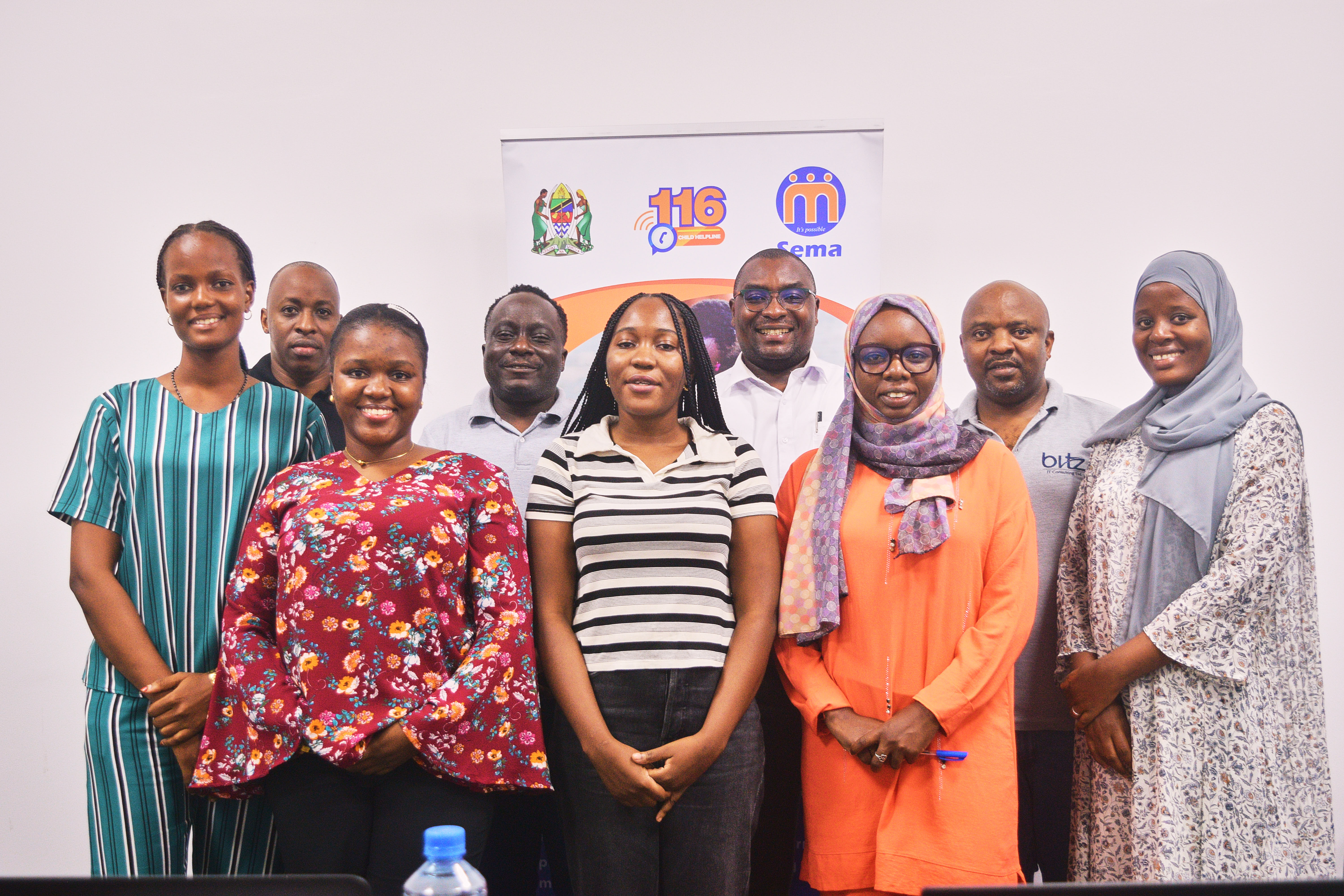
“With UNICEF Venture Fund’s support, we transformed OpenCHS from an operational helpline platform into AI-enabled, open-source protection infrastructure—strengthening case response today while laying the foundation for scalable, country-owned child protection systems across Africa.”
BITZ IT
Child helplines face limited capacity in our call centers. Many helplines may have only two to four counsellors, while the number of calls coming in at any given moment far exceeds what they can handle. That’s where AI becomes transformative. By supporting call management and reducing workloads, AI can help ensure fewer dropped or missed calls and improve service continuity. I hope that more African child helplines will adopt this innovation from BITZ and OpenCHS to strengthen their systems.
Michael Marwa, CEO of C-Sema
Can you describe your prototyping process and how your solution evolved over time?
We prototyped our solution through an iterative, real-world development process that evolved significantly over the investment period.
Our integrated AI solution entered the prototyping phase in September 2025. The first version of the prototype was designed as a multi-stage pipeline that could support Violence Against Children (VAC) workflows within the 116 helpline environment. It processed call audio through Automatic Speech Recognition (ASR), followed by Swahili–English translation, and then downstream NLP tasks such as case classification, named entity recognition, question-answering, summarization, and insights generation. At this stage, we deployed production-ready models trained on publicly available datasets, supplemented with synthetically generated domain-specific data based on Tanzanian call center conditions.
This initial version validated overall architecture, but it also revealed a major limitation: transcription accuracy. The ASR model, trained largely on the Common Voice Swahili dataset, struggled with Tanzanian accents, telephony audio quality, and protection-specific vocabulary. These errors cascaded through the pipeline, reducing the reliability of translation and downstream insights. The prototype therefore helped us identify domain adaptation of ASR as the primary technical challenge.
In response, the next version of the solution shifted toward a data-centric approach. Instead of continuing to optimize model architectures trained on mismatched data, we focused on building infrastructure to collect, annotate, and curate domain-specific audio at scale. We developed an ASR dataset creation system using Label Studio, integrated into our helpline platform through custom middleware.
By December 2025, we had collected and annotated approximately 14 hours of Tanzanian telephony recordings with accurate transcriptions. Fine-tuning the ASR model on this dataset produced substantial improvements, reducing hallucinations and improving accuracy. These gains carried through the entire pipeline—translation became more reliable, and classification, summarization, and insight generation improved significantly. In February 2026, we crossed 100 hours of Tanzanian telephony recordings.
Over time, the prototype evolved from a generic AI pipeline into a continuously improving, domain-adapted system embedded in real helpline workflows. This process has fundamentally changed our strategy from model-centric development to data-centric AI innovation, demonstrating that sustained investment in domain-specific data infrastructure is essential for deploying AI responsibly in child protection contexts.
How has your business model and strategy evolved over the past year, and what are your biggest achievements and growth plans for the next year?
Over the last 12 months, our business model and strategy have evolved significantly as OpenCHS moved from an early-stage helpline platform into scalable, open-source digital infrastructure for child protection systems.
At the beginning of the investment period, our focus was primarily on building and validating the technology in real operational environments. As deployments expanded across multiple countries, we recognized that long-term sustainability in child protection cannot rely on traditional software licensing models. Governments and service providers need systems they can own, adapt, and maintain over time—without vendor lock-in.
As a result, our strategy shifted toward a partnership-driven model centered on government adoption and institutional support. OpenCHS is positioned as shared digital public infrastructure, and our sustainability comes through implementation services, national system integration, training and capacity building, and long-term technical support rather than licensing fees.
One of our biggest achievements this year was validating this approach through growing interest from governments and partners across several African contexts, alongside operational deployments in Kenya, Uganda, Tanzania, Lesotho, and Somalia. We also strengthened our value proposition by integrating the OpenCHS AI Service into the 116 helpline workflow, demonstrating how AI can reduce administrative burden and improve decision support in VAC response.
Over the next year, our business growth will focus on deepening institutional partnerships, expanding deployments through UNICEF and government collaboration, and building a stronger ecosystem of local implementers who can support country ownership. We will continue investing in responsible AI expansion, sustainable support models, and open-source maturity so that OpenCHS can scale as a trusted Digital Public Good across Africa.
Who are the key collaborators you’re seeking, and how can they add value to your business?
As we move into the next phase of growth, we are looking to collaborate with partners who can help scale OpenCHS as shared digital infrastructure for child protection and survivor support systems across Africa.
Do not innovate or develop technology without meaningfully involving the people who will use it. Co creation is essential to building solutions that work.
Michael Marwa, CEO of C-Sema
Our most important collaborators are government institutions, particularly ICT departments and social service ministries, because long-term impact depends on national ownership and alignment with protection protocols.
We also want to work closely with NGOs and frontline organizations supporting children and survivors, as well as UN agencies and regional child protection actors who can expand adoption and strengthen safeguarding standards.
On the technology side, we are seeking partnerships with AI research institutions and universities to support multilingual model development and responsible innovation.
What are you most excited about for your company next year, and what are your main goals?
Looking ahead to next year, we are most excited about entering a true scaling phase for OpenCHS—expanding deployments, strengthening our AI capabilities across countries, and positioning the platform as regional digital public infrastructure for child protection and survivor support.
One of our main goals is to grow OpenCHS into additional operational contexts through a phased approach with government and UNICEF partnerships. Countries such as Eswatini (Swaziland) and South Sudan are high on our wish list, where stronger digital helpline and case management systems could significantly improve protection response. Our aim is to work with UNICEF and national stakeholders to explore adoption pathways and support gradual rollout as readiness and resources align.
We are also focused on moving beyond our initial AI prototyping work in Tanzania. Over the next year, we want to adapt and train models for other countries where OpenCHS is already operational, ensuring that AI performance reflects local languages, workflows, and protection realities across diverse contexts.
Another major goal is to strengthen OpenCHS as a regional technical support and implementation partner for Africa. As more governments adopt digital case management and AI-enabled helpline services, there is a growing need for trusted regional expertise in deployment, safeguarding, training, and long-term system maintenance. We want OpenCHS to play that role.
Finally, we will continue investing in our position as a leading Digital Public Good—expanding open-source collaboration, improving interoperability with national systems, and ensuring that countries can adopt and sustainably own the platform without vendor lock-in.
Overall, next year is about scaling responsibly: supporting phased expansion into new countries, strengthening AI across deployments, and building the institutional foundation for OpenCHS to serve as shared protection infrastructure across Africa.
How has the UNICEF Venture Fund supported your solution beyond financing?
The UNICEF Venture Fund has been instrumental in accelerating the growth of OpenCHS over the past year. Beyond the financing, the Fund provided strategic support that helped us strengthen not only the technology, but also the business and operational foundations needed for long-term scale.
A key area of value was guidance on our business model and go-to-market approach. The Fund helped us refine our strategy away from traditional licensing and toward a partnership-driven model focused on government adoption, implementation support, capacity building, and long-term institutional ownership. This has shaped how we approach sales and growth—prioritizing trust, integration, and sustainability within public protection systems.
The Fund also strengthened our development practices. Through structured milestones and mentorship, we improved our engineering discipline, introduced stronger QA processes, expanded automated testing, and built more reliable deployment pipelines—ensuring the platform can operate as production-grade infrastructure.
In addition, UNICEF’s emphasis on privacy, safeguarding, and open-source accountability pushed us to mature significantly in these areas. We improved our compliance with Data Protection Guidelines, formalized governance and contribution structures, and established OpenCHS as a transparent digital public good that governments can adopt without vendor lock-in.
Finally, the Fund provided critical guidance on responsible AI. This support helped us prototype the AI Service in a careful, human-centered way—integrating transcription, translation, summarization, and triage insights into helpline workflows while ensuring human oversight, quality assurance, and ethical safeguards remain central.
Overall, the Venture Fund delivered far more than capital: it provided mentorship, accountability, credibility, and strategic direction across business, technology, privacy, open source, and responsible AI—positioning OpenCHS for sustainable growth and impact across Africa.