Portfolio News

Blockchain Boost for Burundi's Youth Solidarity Groups

Jan 08 , 2026
Blockchain Burundi
On this page

Overview

Amid economic hardship, health challenges, quality of education issues and poor support for out of school, young people in Burundi are turning to self-reliance and community engagement through solidarity groups. These groups empower young people to achieve financial self-reliance.

With financial support and technical oversight from UNICEF’s Office of Innovation, BX Smart Lab, a Venture Fund investee startup, supported UNICEF Burundi Country Office in developing a financial registry application based on blockchain technology. 

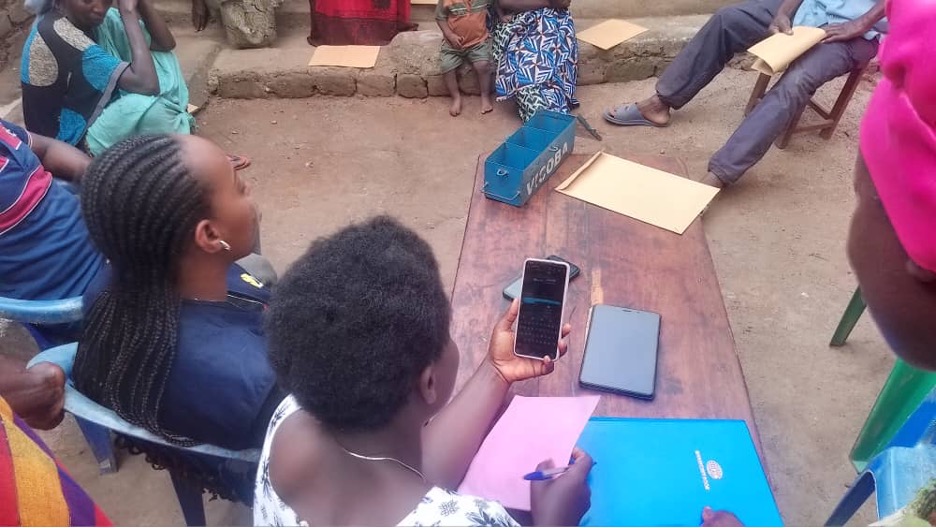
UNICEF Burundi aimed to strengthen transparency and creditworthiness in the savings and loans transactions of young people within their solidarity groups, as a key strategy to unlock financial services from microfinance institutions (MFIs) for unbanked youth. The application currently runs on smartphones with internet connection to operate the app, however, there is no need for a smartphone for each member of the group, 1 phone per group proved to be effective for the group finances registration.

The project had 3 main phases:

  • Design and development
  • Data collection to calculate credit scores (by onboarding solidarity groups)
  • Loan process (by onboarding local microfinance institutions)
Blockchain Burundi

Phase 1: Design and Development

The project started with a three-day design sprint—a methodology for answering critical questions through design, prototyping, and testing ideas with customers—in Bujumbura, Burundi, where the team had to rethink the target customer. Initially, the app’s design focused on streamlining workflows for the youth groups themselves. However, the design sprint revealed that the app’s success depended on meeting the needs of local credit organizations (such as banks or microfinance institutions), which would ultimately decide whether to provide loans. This pivot shifted the project’s emphasis to unraveling the data that banks value, such as attendance rates, repayment histories, and loan purposes. 

Regarding the blockchain system, it was decided to proceed with the C-Chain of the Avalanche blockchain for two primary reasons: 

  • Ensuring the future scalability of this solution by deploying “subnets” enabled by avalanche i.e. one can run a separate blockchain without the burden of paying transaction fees with globally traded cryptocurrencies
  • Ensuring the portability of this solution to other “EVM Compatible” blockchains i.e. this solution can find a home in some of the most popular blockchain ecosystems, thus ensuring technical support or growth potential.

For this pilot, the youth in Burundi never held any cryptocurrencies or any tokens on the avalanche blockchain. The transaction fees was paid by the BX Smart Labs, through a mechanism which allows a sponsor from anywhere in the world to pay transaction fees. We see this as a good mechanism to enable usecases on public blockchains (for efficiencies in data sharing and public accountability), but in jurisdictions where citizens are not allowed to hold cryptocurrencies.

Phase 2: Data Collection to Calculate Credit Scores (by onboarding solidarity groups)

The blockchain-based application was tested initially with 2 youth groups; later further expanded the pilot with 13 groups where members recorded incoming savings and outgoing loans, which helped identify feature gaps and areas for improvement in the group dashboard. After technical adjustments, participants expressed satisfaction with the app and recognized its usefulness.

Originally, the app required groups to onboard themselves by entering retrospective financial data. During the first training, the team observed that the lengthy onboarding process consumed valuable meeting time and affected group engagement. The approach was therefore adjusted: training partners collected data one week in advance and uploaded it on the back end. This also helped address challenges caused by unstable internet connectivity, which had led to data losses during self-onboarding.

Offline functionality—initially underestimated—proved essential to the app’s successful rollout. Although the app was designed for low-bandwidth environments, it still required connectivity to upload data. Even in peri-urban areas such as Rumonge, internet instability hindered real-time updates. Without offline mode, groups would likely have lost patience while waiting for basic entries, such as attendance records, to upload.

The use of password protection was introduced to increase trust in the digital registry. However, during training, members expressed that trust within groups was already strong, and the additional step slowed meetings considerably. While intuitive from a design perspective, it proved burdensome in practice. Its real value may be appreciated primarily by MFIs, if at all.

Phase 3: Loan Process (by onboarding local microfinance institutions)

Establishing partnerships with microfinance institutions (MFIs) to facilitate accessible loans based on verified credit histories was not realized during the project period. Engagement with MFIs generated valuable learning, notably that while there was interest in group-based lending modalities, existing risk frameworks, sectoral preferences and conservative loan sizing limited alignment with the initiative’s objectives. Procedural requirements associated with formal lending, combined with local operational constraints related to training and onboarding arrangements, further affected the feasibility of concluding partnerships.

Overall, the Hezafin application demonstrated value as a practical tool for youth groups seeking greater financial autonomy and mutual support. The platform is expected to be introduced in another country context to further test engagement models with MFIs and assess conditions for successful integration with savings groups.

Share this story
Stories by this author

Insights on the stablecoin-based end-to-end cash transfer platform test

Read Story
Katalin Erzsebet Illes
Product Manager (WEB3)