
Cirrolytix's Journey to Revolutionize Dengue Prediction with AEDES
Introduction
Cirrolytix graduated from the AI & Data Science Cohort for Learning and Health (2022-23). This blog highlights Cirrolytix's journey, successes and challenges, and the vision of their technology to improve public health outcomes.
Advanced Early Detection and Exploration Service (AEDES) for Dengue
Our journey at CirroLytix began with a clear and steadfast vision: to create a sustainable future by harnessing the power of big data, analytics, and AI to advance innovations in risk management. We aimed to empower the public sector and non-profit organizations with multimodal, multidimensional dashboards, enhancing their capability to make informed and impactful decisions. This vision led to the creation of AEDES.
Prototyping: The Genesis and Evolution
The journey of creating AEDES has been full of learning and growth. It all started with a small idea – to use technology to help predict and fight dengue.
Version 1 marked the dawn of AEDES. Born out of the NASA Space Apps Challenge 2019, the first iteration was a blend of datasets from the Department of Health (DOH), the Philippine Atmospheric, Geophysical and Astronomical Services Administration (PAGASA), and Google Trends, coupled with Sentinel-2 images via QGIS. This version, though nascent, laid the foundation by showcasing a dengue hotspot map and alerts with forecasting capabilities.
The journey from Version 1 to Version 2 was a stride towards expansion. We added more locations to our system and used a new method for forecasting dengue trends. This update helped us improve the accuracy of our predictions.
Transitioning to Version 3, the horizon of AEDES expanded further. With the integration of remote sensing indices from Google Earth Engine and places of interest from OpenStreetMap, we enhanced the granularity of analysis to provincial weekly cases, from the previously regional monthly level. The launch of a PyPI library (aedes) and the uploading of data to HDX marked milestones in enhancing accessibility and collaboration for those using AEDES.
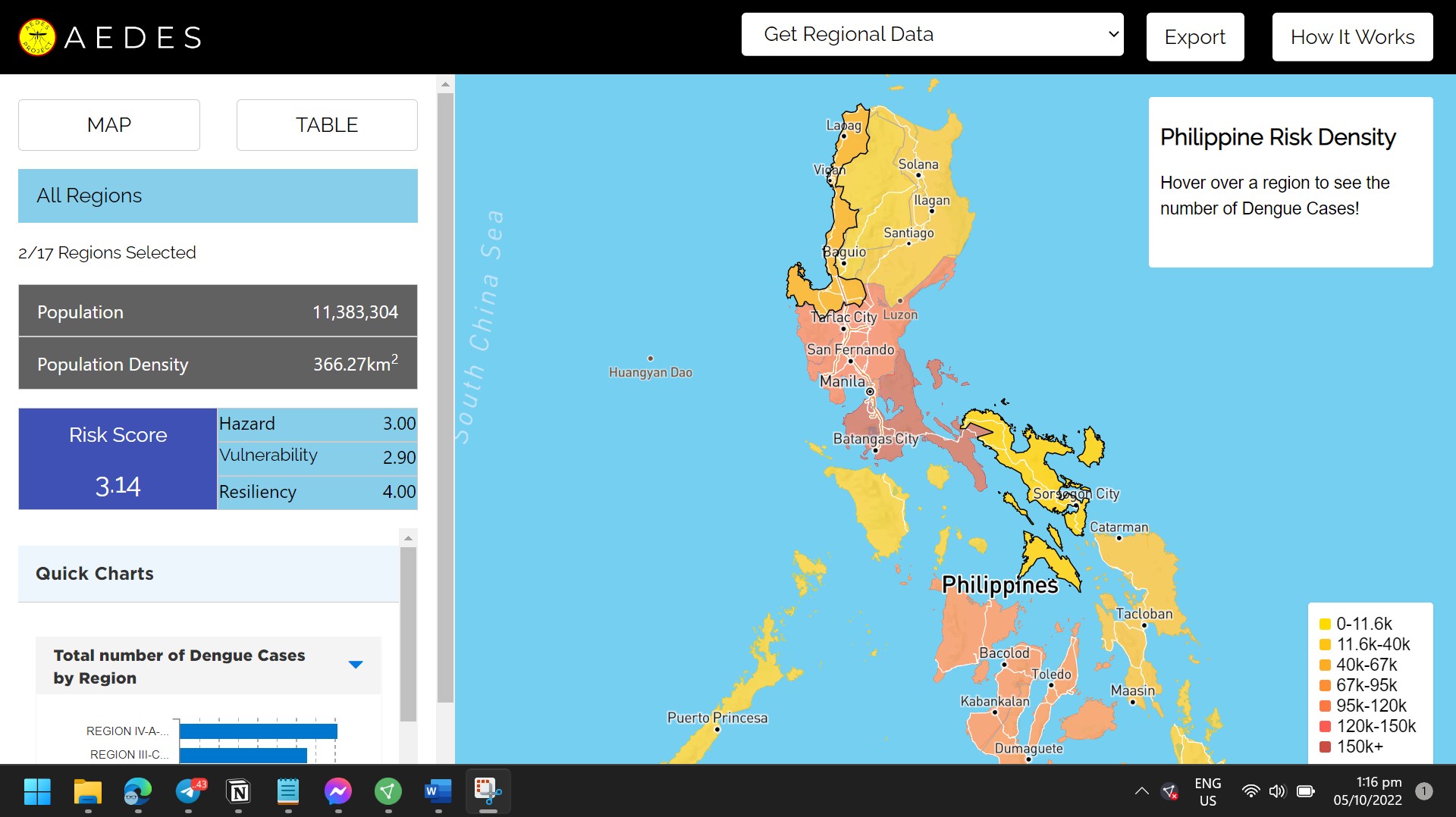
The evolution to Version 4 epitomized automation and expansion. We transitioned to advanced data sources (e.g., NASA AppEEARS and NASA Worldview for satellite images and NASA POWER for meteorological data), as well as automating data extraction, preparation, machine learning, and prediction. The inclusion of additional data sources such as administrative boundaries from www.geoboundaries.org, and population density and relative wealth index from Meta Data for Good, enriched the AEDES dashboard, now featuring multidimensional risk scores inspired by the European Commission's Joint Research Centre INFORM Risk Framework.
However, the journey was not a smooth sail. The integration of diverse, multifaceted data sources presented challenges in synchronization, scalability, and real-time analysis. The quest for a seamless, intuitive interface design was a navigation through trial, error, and continuous learning. Despite these challenges, our team stayed committed. We learned from each issue we faced and used these lessons to improve AEDES at each step.
Key Achievements: Pivotal Milestones in the Journey
In a year marked by relentless progress, a defining achievement illuminated our path. Our dedicated efforts in combating dengue culminated in a pivotal collaboration, marked by the signing of a Memorandum of Understanding with the Philippine Pediatric Society-Southwestern Mindanao Chapter. This partnership will empower community-level interventions with critical insights from AEDES, transforming forecasts and hotspot detection into actionable strategies for dengue control.
The synergy of our collaboration and technology set the stage for a groundbreaking research study in Zamboanga City, delving into the impact of early community-based dengue control programs utilizing AEDES forecasts. This initiative caught the attention of the Department of Science and Technology, earning us a crucial research grant for the evaluation of the program in Zamboanga City. But the journey didn’t stop there.
Our commitment to innovation and impact echoed beyond local borders, leading our research study to be accepted for presentation at the esteemed Evidence and Implementation Summit 2023 Conference in Melbourne, Australia, scheduled for October 9-11. Under the resonant theme, "Context counts: Translation, adaptation, and transportability of evidence across people, place, culture, and systems," our team is prepared to showcase our study, “Designing Innovative Solutions to Service Unreached Populations in Communicable Disease Control in the Philippines.”
This cascade of achievements, from local collaborations to international recognitions (e.g., High Commendations under the Resilience, Resource Quality, Safety and Protection of Life category of Geovation Awards International Innovation Awards 2023), underscores the transformative impact and potential of AEDES, solidifying our resolve to continue our mission of enhancing public health and global resilience against dengue.
Challenges: Path of Enlightenment and Hurdles
Embarking on the journey to transform AEDES has been a path filled with both enlightenment and obstacles. The evolution from a consultancy to a product-led social startup has been a significant pivot, bringing forth challenges in achieving Product-Market Fit (PMF) within a constrained timeframe. This transition underlined the critical importance of timely and diverse mentorship. The insights gained emphasized the value of a balanced approach, combining consultancy projects aligned with AEDES's mission, thereby contributing to its continual development.
Resource challenges presented another hurdle. The attrition and redeployment of key project resources led to certain delays, a situation further compounded by external financial fluctuations. This experience underscored the crucial need for financial stability and adaptability, highlighting the importance of a flexible and resilient approach to project management and execution.
The decision to expand AEDES beyond dengue, upon mentorship advice, added a layer of complexity to our development process. This expansion, while essential for broadening the impact of AEDES, brought to light the importance of maintaining a harmonious balance between technological advancement and business viability. Ensuring the platform's financial sustainability is as crucial as its technological robustness for the enduring success and impact of AEDES.
Looking ahead, the path is lined with opportunities intertwined with challenges. The open-source model of AEDES stands as a beacon of global collaboration, promising continual enhancement and adaptation of the platform. However, it brings forth the task of ensuring consistent and high-quality contributions, maintaining the platform's integrity and reliability.
In terms of business viability, the strategic extension of AEDES to other critical risk areas such as climate, disaster, and political risk, and to diverse locations, opens new horizons for monetization and impact. This expansion enhances the platform’s relevance and applicability, paving the way for increased revenue streams while amplifying its global impact. Ensuring this balance between expansion, accessibility, and financial health is paramount for the sustained growth and evolution of AEDES.
Open Sourcing AEDES: A Gateway to Global Collaboration
By open-sourcing AEDES, we are tapping into the global reservoir of diverse talent and expertise. Developers, researchers, and healthcare professionals from around the world now have the opportunity to contribute to, critique, and enhance the AEDES platform. This global collaboration enriches AEDES, ensuring it is constantly tested, improved, and adapted to meet the evolving challenges of disease prediction and management. It allows us to integrate diverse perspectives, skills, and insights, ensuring the platform is robust, resilient, and ever-evolving.
Open-sourcing AEDES is not just about enhancing the platform's technical capabilities. It’s about building a global community united by a shared mission to harness technology for societal good. It's about ensuring that AEDES is not just a tool but a global collaborative effort to make a tangible difference in the world.
Beyond these benefits, open-sourcing AEDES is a strategic move towards enhancing its product-market fit and uncovering diverse revenue streams. The global exposure and adaptability ensure AEDES is attuned to real-world, varied needs, enhancing its appeal and relevance across various markets and user segments. While the core platform remains open and collaborative, opportunities for offering value-added services, expanding to other risk areas, forming partnerships, and developing advanced licensed versions provide substantial avenues for monetization.
The open-source model propels AEDES into the realm of global collaboration and innovation. It provides a transparent, inclusive space where the platform can be continuously scrutinized, refined, and perfected. It ensures that AEDES remains adaptable and relevant, capable of meeting the diverse needs and challenges of communities worldwide.
User/Field Testing: Gleaning Valuable Insights
Embarking on user testing for AEDES was a significant milestone, a harmonious confluence of technology and real-world expertise. The partnership with medical students from Ateneo de Zamboanga and doctors from the Philippine Pediatric Society-Southwestern Mindanao chapter provided a wealth of practical, on-ground insights that are invaluable for the refinement of AEDES.
Feedback praised the intuitive layout and design of the AEDES platform, but also pointed out areas for improvement. Users identified challenges related to mobile accessibility and browser compatibility. The need for enhanced navigation assistance, performance optimization, and more diverse alert settings were emphasized. Users also expressed a desire for additional features for demographic analysis, disease tracking, and community database creation.
These insights and feature requests are precious to us, and they will form part of the next evolution of AEDES. While these enhancements are not yet underway, our plan is to address these issues with the help and expertise of the broader open-source community. This collaboration will ensure the continuous improvement and effectiveness of AEDES in making a tangible difference in global health management.
Future Collaborators: Forging Strategic Partnerships
As we move forward on AEDES's path of growth and innovation, our approach to collaboration is both intentional and strategic, aimed at optimizing the synergy and impact of each partnership.
Public Health Organizations and Research Institutions: Our collaboration roadmap with public health organizations and research institutions is anchored on mutual learning and impact. We will leverage existing networks and platforms, such as conferences, forums, and research collaborations, to engage with potential partners. Our anticipated presentation at the EIS 2023 Conference stands as a valuable opportunity to connect with global public health and research communities, fostering partnerships for enhanced impact and innovation.
The publication of research papers and case studies detailing the development, implementation, and impact of AEDES will also serve as a valuable tool to reach global public health and research communities. This approach not only shares the AEDES story but also contributes to the global knowledge base on innovative solutions for disease prediction and management.
Technology Companies and Open-Source Communities: To engage with technology companies and open-source communities, we will actively participate in technology forums, conferences, and hackathons. Our commitment to open-source principles, demonstrated through the open-sourcing of AEDES, will facilitate vibrant engagement with global open-source communities, ensuring continuous technological enhancement and innovation.
Government Agencies and Non-Profit Organizations: Our path to collaboration with government agencies and non-profit organizations is facilitated by our existing partnerships and networks. Having worked with UNICEF Philippines and UNICEF Office of Innovation, as well as other agencies such as WHO, we have access to a robust network of government and non-profit organizations. We will leverage these networks for impactful collaborations, ensuring AEDES's seamless integration and deployment in diverse public health ecosystems.
Climate and Environmental Organizations: As we expand AEDES to other critical risk areas, our engagement with climate and environmental organizations will be strategic. We will actively engage with global climate and environmental platforms, contributing our insights and learning from global experts to enhance AEDES's impact on climate and environmental health.
In addition to these strategic paths to collaboration, our existing partnership with the Philippine Pediatric Society-Southwestern Mindanao Chapter further strengthens our engagement with the public health community, providing a robust foundation for expanded collaborations and partnerships.
What's Next: Focused Priorities
In the journey ahead, AEDES holds fast to a clear set of priorities, anchoring its path in dedicated research, expansive outreach, and innovative integration. Our immediate focus remains on completing the ongoing research study "Evaluation of Early Community-Based Dengue Control Program Using Project AEDES Forecast in Zamboanga City" alongside the Philippine Pediatric Society - Southwestern Mindanao Chapter. This endeavor underscores our commitment to substantiate the real-world impact of AEDES, aligning technology with evidence-based insights.
Parallel to our research efforts, building a robust sales funnel for AEDES stands as a significant objective. This initiative aims to amplify AEDES's presence, bringing its advanced capabilities to diverse regions and enhancing its global footprint. The goal is clear: extend the reach of AEDES, ensuring that its innovative solutions resonate across boundaries, bringing tangible benefits to communities worldwide.
In tandem, securing consulting projects that resonate with AEDES's mission is paramount. Such collaborations pave the way for the expansion of AEDES into other critical risk areas, enriching its scope and reinforcing its relevance in navigating diverse global challenges. This strategic approach not only augments AEDES's operational capabilities but also bolsters its impact, aligning with broader global objectives and needs.
UNICEF Venture Fund: Anchoring AEDES in Collaboration and Growth
The support from the UNICEF Venture Fund has been more than just financial; it has been a guiding light for the growth and enhancement of AEDES. This backing has amplified our presence, opening doors to a worldwide network of like-minded individuals, organizations, and potential users, all committed to using technology for real-world impact. Such recognition has been crucial in forming key partnerships, notably with the Philippine Pediatric Society. This collaboration has significantly strengthened our efforts in data collection, validation, and community interventions, making a substantial difference in community health.
In addition to this, the Fund has connected us with a diverse group of mentors and experts, offering insights and guidance on product development and market engagement. This network has been invaluable in navigating the complexities of bringing a product like AEDES to the market. The comprehensive support from the UNICEF Venture Fund ensures that AEDES stands strong as a crucial tool in the global battle against dengue and other mosquito-borne diseases.
This is just the beginning. As we expand AEDES to other critical risk areas such as climate, disaster risk, and political risk, our mission to make a significant impact on society continues to grow and evolve.
Related Stories


