
Q&A with Sunita Grote, Senior Innovation Advisor, UNICEF Ventures

main content start
Ever wondered how AI or blockchain could make your work more effective and impactful?
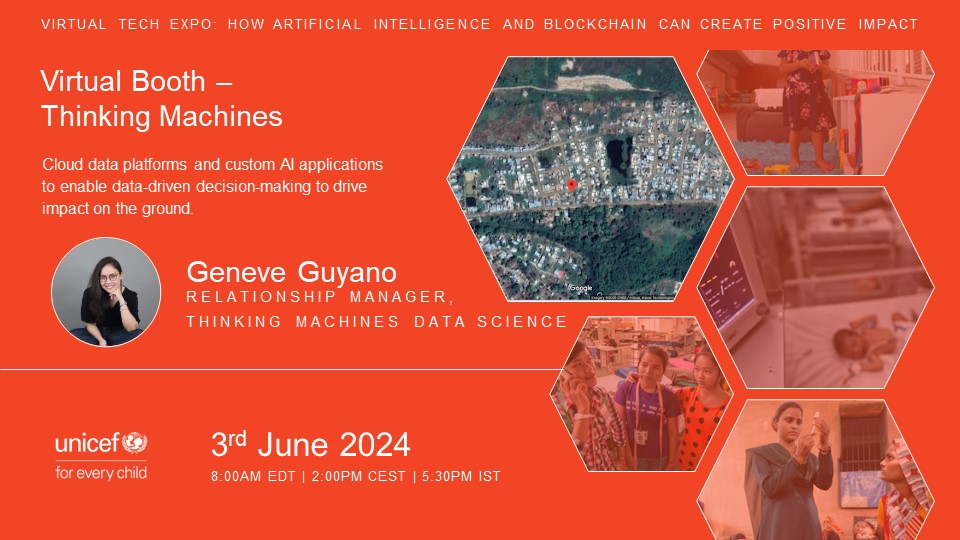
Office of Innovation hosted a Virtual Tech Expo on AI and Blockchain for Positive Impact to share knowledge and discuss with experts from different fields how to use the potential of frontier technologies to solve large-scale challenges and bring radical change for children and the world.
The event gathered 110+ specialists in innovation, ICT, health, social policy, and education among others, who joined the virtual event to hear directly from the startups supported by UNICEF Venture Fund how their solutions transforming health, education, emergency response and beyond, can support and accelerate implementation on the ground.
CHECK THE VIRTUAL BOOTH SESSIONS FOR A DEEP DIVE INTO THE SOLUTIONS PRESENTED AT THE VIRTUAL TECH EXPO
What are some of the biggest challenges that you or your team has faced when implementing AI and blockchain solutions in the field?
Some of the challenges for organizations like UN are about the newness and the speed of these technologies, particularly AI and blockchain are two that evolve constantly. And there are new applications that are being developed all the time. And we as the UN system are not always the fastest in terms of being able to respond and leverage those.
There is mismatch in the speed and agility between the two worlds and bringing those together can sometimes be challenging, but when it works out, it's really fascinating and interesting to see how that difference becomes a real value added in collaboration.
What are some of the risks that we need to be aware of?
One of the big risks we have is being able to account for the needs of the most vulnerable and the most marginalized and that can sometimes be hard to demonstrate in the moment. It is one of the reasons why the focus of the presentation is on setting the scene for the future as well. It is very helpful to look at what the world will look like in five years’ time.
When we pilot technology now, in our experience we see that it takes five to six years before that solution and platform gets adopted by several country offices or in different countries. And by then the world could look quite different in terms of access, adoption, literacy and engagement with those technologies. It’s important to understand the limitations, but at the same time to think about designing something that is for the foreseeable future as well.
Can you share expertise or examples to guide governments in designing AI related laws?
I would direct you to the policy guidance that UNICEF has issued on AI for children. It’s a great starting point to look at what some of the key considerations are when we advocate and engage with governments to make sure that the rights of children are respected.
And we as UN agencies definitely have to build our own capacity to be able to guide governments in those conversations as well. I would say it's an area that we will probably see quite a bit of growth in within our own capacities over the coming years
How can emerging technologies like AI and blockchain be leveraged within the Bibliotech program (i.e. a program transforming public spaces into safe internet environments) to further enhance the safety and digital literacy of youngsters online? Could you share some specific strategies or examples that have been successfully implemented?
As far as blockchain in concerned, there is the approach of incentivizing the youth to learn / perform some tasks for self-development. We can also leverage digital ID powered by blockchain systems to enable access to growing global platforms delivering educational content or use the blockchain ID (the token behind it) to store certificates / credentials on work completed, thereby creating an online CV of sorts, which can be trusted by job providers or connect them to protocols offering financial inclusion products etc. A platform which is building this approach is https://yoma.world/
Related Stories


Portfolio News
June 17, 2026

Portfolio News
June 17, 2026

Portfolio News
June 17, 2026

Portfolio News
June 16, 2026
