
Tech Outlook 2026: Blockchain Building Blocks for Scalable Impact
Our 2025 outlook included key trends and use cases (most of which have been executed or explored in pilots). In this 2026 piece, we focus on use cases—reaffirming why blockchain remains essential for UNICEF, outlining a modular prototyping approach—and an outlook that reflects on how advances in AI can meaningfully intersect with the blockchain work.
Trends
We’ve observed the following noteworthy trends, where we have already executed pilots or are in stages of advanced research:
- Stablecoins and digital assets for financial flows. Stablecoins are cryptocurrencies whose values are pegged to a reference asset, such as a traditional currency. With the massive growth trajectory of stablecoins pushed by regulatory tailwinds, there are incredible possibilities for growth in fundraising, treasury, payments, aid, etc.
- Public immutable ledgers. Going back to the basics of what a blockchain is, this characteristic lends itself to adding more granularity and “proofs” to UNICEF transparency dashboards and impact tracking.
- Multi-stakeholder data sharing. Smart contract-based workflows in supply chains, procurement, financial inclusion, etc. can reduce costs and improve efficiencies for a global operation such as UNICEF.
- Privacy, Trust, Security. Approaches such as Zero Knowledge Proofs, Multi Party Computation etc. enable privacy and security related use cases such as unique human IDs, verifiable credentials, and provenance of information which will gain importance in the online environment of the future, especially relevant for protecting children from online threats.
- Stakeholder Engagement. UNICEF engages with thousands of stakeholders, from institutional donors across high-income countries to young people in the communities we serve. There is potential for a future where maturing Web3 governance mechanisms and tooling can help supercharge such engagements in use cases such as community-powered fund allocation, youth driven localization for humanitarian response, donor engagement (beyond social media), etc.
Integrating Building Blocks into Scalable Solutions
As these pilots progress, we increasingly see opportunities to combine individual components into coherent, scalable systems. Examples include:
- Directing a portion of the proceeds from our impact staking pools to DRIP lists could potentially create a steady stream of sustainable “passive income” to mature DPGs.
- Connecting weather oracles with the payment infrastructure built by the financial inclusion cohort could create climate events-based payments for anticipatory-action programs.
- Combining open-source solutions (wallets, offramps, disbursement platforms, dashboards) built by the Venture Fund portfolio could solve for delivering stablecoin-based aid to those with no internet access. An initial exploration of this has already been executed in Kenya.
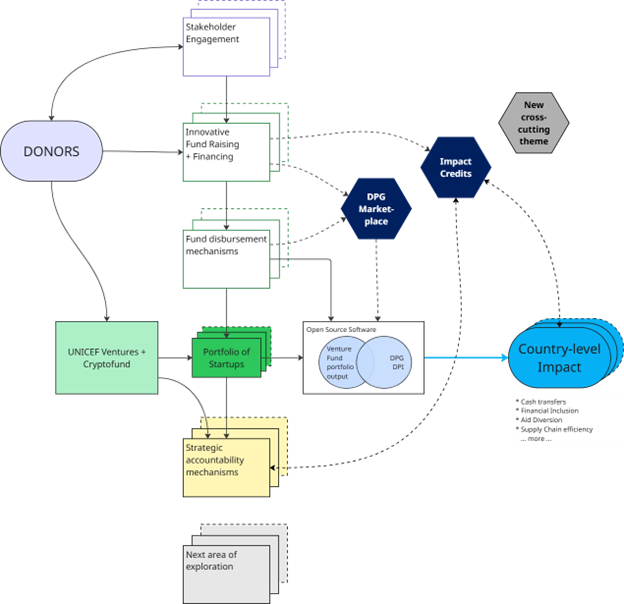
As we keep working with our modular components, we are noticing cross-cutting themes emerging and an evolution of the work itself, which are:
- DPG Marketplace: A multi-stakeholder platform that combines modular components from fundraising, fund disbursement, and open-source digital public goods. The purpose of such a platform would be to not only fund Digital Public Goods but also match them with institutional partners seeking scalable, open-source solutions.
- Impact Credits: A data-driven model that blends components from strategic accountability and innovative financing with new approaches to measurement/evaluation to mobilize capital for systems strengthening and project sustainability at the country office level.
Outlook
Through this approach, we have been observing a clear evolution:
- From individual pilot projects toward platforms and ecosystem-level solutions.
- From digital-only impact toward tangible, real-world impact
We wish to continue utilizing non-financial applications of blockchain in use-cases to solve for efficiencies of workflows, privacy, online trust and community participation. We will leverage regulatory tailwinds around stablecoins to test innovative financial flows which would be faster, cheaper, more accountable and more inclusive.
We are hopeful that this manner of approaching blockchain innovation –with small pilots, creative combinations and openness for larger themes - would yield more impact in the future.
We are curious about how AI may meaningfully meet blockchain. This is a fast-evolving area, but so far certain ideas are interesting to explore. For instance,
- We are curious about approaches like Deepfunding, where AI models are discovered to optimally allocate funding towards open-source projects. Can we also approach the DPG ecosystem with a similar AI-based approach to effectively measure project maturity, project adoption, project impact and other metrics which are not simple to measure?
- We noticed the x402 protocol, which is an internet native payment protocol which runs on HTTP. It may now be easier for AI agents to financially transact using blockchain rails, at scale. Therefore, is there potential for future agentic workflows for UNICEF (e.g. impact verification, youth/citizen voice assimilation, localization of humanitarian aid through surveys and negotiations etc.) to be directly funded through blockchain based smart contracts, seeded by donors?
Stories by this author
DAOs (Decentralized Autonomous Organizations): Do they make sense for UNICEF?
Read StoryRelated Stories


