
Bridging Community Savings and Microfinance: Human-Centered Design in Action in Burundi

Role of Human-Centered Design in Complex Contexts
The project kicked off with a three-day design sprint—a methodology for answering critical questions through design, prototyping, and testing ideas with customers—in Bujumbura, Burundi. The sprint was driven by a team comprised of included youth representatives, UNICEF staff, and a bank partner, representing voices from the business and from customers.
“Decision-making is often a lengthy process, but the sprint catalyzed quick, actionable decisions,” says Prateek Upreti, User Experience Mentor at the UNICEF Office of Innovation.
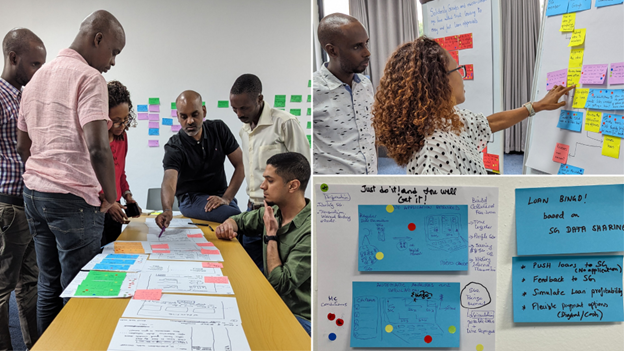
A standout feature of the sprint was its ability to catalyze decision-making in a space often hampered by lengthy deliberations.
Prateek shares, “The sprint starts with understanding the nature of the problem and then moves into the realm of creative ideation followed by prototyping the most compelling ideas. In this journey, the participants have to make a lot of decisions and that could drain out the group, even before we get to the good ideas. The sprint methodology ensures timely decisions, even when perfect consensus isn’t reached.”
This structured approach prevented delays and helped align stakeholders toward shared goals, all while ensuring that diverse perspectives were not only included but acted on where relevant.
Prateek explains, “The loudest voice in the room is not the only one that’s heard. The sprint methodology emphasizes the quality of ideas, not the sheer quantity of it or the quality of speech.”
In the course of the activities and ideation, the team had to rethink the target customer. Initially, the app’s design focused on streamlining workflows for the youth groups themselves. However, the sprint revealed that the app’s success depended on meeting the needs of banks, which would ultimately decide whether to provide loans. This pivot shifted the project’s emphasis to unraveling the data that banks value, such as attendance rates, repayment histories, and loan purposes.
“No matter how usable the digital registry is, it won’t matter if banks don’t trust and see value in the data. That realization shifted our design from focusing on youth workflows to what banks needed to assess creditworthiness,” Prateek adds.
Future Direction
The Burundi project underscores the power of HCD to transform development work. By fostering co-creation and testing assumptions early, the project avoided common pitfalls of designing in isolation. The decision to test a no-code prototype with banks enabled the team to gather immediate feedback and refine their approach before full implementation.

The pilot phase, set to launch early this year, will generate six months of transaction data to secure initial loans to these youth groups. If successful, this model could inspire scaling efforts across the region, bridging the gap between community savings groups and microfinance institutions. However, the project is mindful of the challenges to sustainability, especially in cases where unpredictable political climate and the question of sustained government commitment pose risks to the long-term viability of the initiative.
Despite these hurdles, the project offers a blueprint for empowering marginalized communities through inclusive innovation and highlights how efforts like these, while challenging and uncertain, are essential steps toward addressing systemic barriers and fostering sustainable, impactful change.
Stories by this author
How UNICEF Yemen Transformed Cash Transfer Programming From Reactive to Real-time Accountability
Read StoryRelated Stories


