Team Insight

The Primero DAO Pilot – Introduction, Progress, Learnings, Outlook

Jan 08 , 2026
Photos are for illustrative purposes only, not directly represnetative
On this page

Introduction

Primero is a widely deployed digital transformation tool for social workers supporting children and survivors of violence. Primero is not only used in more than 80 countries but is supported by multiple agencies who deal with child protection and gender-based violence, including UNICEF. 

Decentralized Autonomous Organizations (DAOs) are a revolutionary concept in the blockchain and digital asset space, offering a new way to organize collective decision-making, manage shared resources and act towards a common purpose. 

(Please refer to this article for a background on DAOs and how this pilot came about.)

Ideas and Hypotheses


The main ideas and hypotheses for the Primero Decentralized Autonomous Organization (DAO) were to enable the following: 

  • Retaining relevance: Being a multi-agency, multi-country tool with thousands of stakeholders, can the central Primero think tank make relevant decisions by involving their community in an open DAO discussion forum?
  • Technical sustainability: While Primero has benefitted from hundreds of altruistic contributions of time/effort to develop their code/content base, can this be made more sustainable and focused by incentivizing contributions from the wider developer community through mechanisms such as bounty programs in exchange for digital asset rewards?
  • Financial sustainability: If Primero is enabled with a digital asset treasury, can we explore options to benefit financially from tapping into the various sources of funding for public goods available in Web3? 

Core Components and Flow

The Primero DAO was therefore conceptualized with elements of a protocol DAO—i.e., a DAO which decides the roadmap of a software product (see more DAO types here) with the main components being:

  • A governance token i.e. an on-chain right to vote on Primero product proposals (distributed initially to some who have historically proven their mission alignment with Primero)
  • A discussion forum for the community to gather and discuss next steps for Primero, including refining any proposals, attaching $ value to them based on estimated effort, discussion on the quality of submitted work, certifying work for getting paid etc.
  • A blockchain wallet enabled platform for voting members to vote on proposals
  • A community owned digital asset treasury to fund any proposal that passes the voting stage

These components have certain systems, rules and methods in place for the members of the DAO to follow – for e.g. a code of conduct for the community, guidelines on who can get voting rights, guidelines on how pull requests connect back to the original proposals, community management, community calls etc.

The overall flow proposed looked like this:
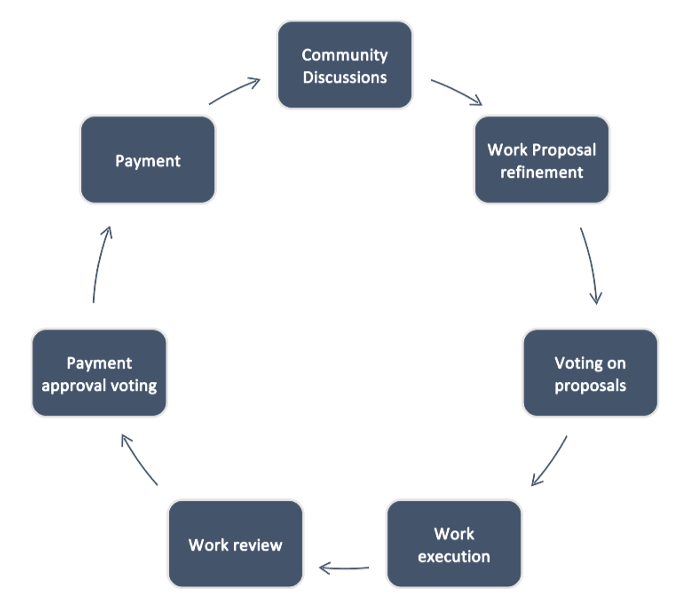


Other considerations for the technical build included: 

  • Off-chain governance process i.e. the voters need not directly interact with the blockchain (ensuring ease of access for members with limited or no experience with blockchains)
  • Leverage open-source DAO tooling with minimal custom coding
  • Utilize integrations offered by these tools as much as possible to connect all components together

The technical build was delivered and managed by XCapit, a UNICEF Venture Fund portfolio company specializing in Web3 products and services with a special interest in financial inclusion, social mobility and education around Web3.

Progress

The pilot kicked off in earnest at the end of 2023. Some highlights in one year of operation include:

  • 35 members in the community discussions forum
  • Representation from 12 countries and 4 regions
  • Public sector representation from UNICEF and International Rescue Committee, with input represented from government/ministry partners and UNHCR
  • Representation from Child Protection specialists, deployment specialists, technical specialists, system administrators and end users
  • 18 proposals were discussed, out of which 5 proposals were voted upon and executed
  • 5 voting members with representation from 1 non-UNICEF stakeholder
  • Revision and publication of code contribution guidelines aligned with the DAO

Learnings

The DAO was an effective advocacy platform for persuading apprehensive government partners to adopt Primero. One common obstacle for uptake when advocating for the use of digital public goods such as Primero is the perception of lack of product ownership, and specifically, limited opportunities to influence the direction of product development. The DAO successfully addresses this by i) demonstrating the product team’s openness to inputs on the direction of product development ii) providing means and incentives for in-country developers to learn how to contribute code to Primero.

Here are some observations about specific aspects of the DAO:

  • Proposals without active facilitation struggled to gain momentum. Members were more comfortable surfacing issues informally than initiating formal proposals, suggesting proposal creation itself is a friction point.
  • Non-technical participants were slow to engage in forum-based discussions, indicating a need for stronger facilitation or more intuitive engagement tools.
  • Even participants with no prior blockchain experience were able to use wallets and vote with minimal friction.
  • Technical review discussions failed to gain traction on forums because teams already used GitHub; tighter platform integration would improve participation.
  • Limiting access to a non-tradable governance token (one token per voter to limit unauthorized delegation) in a closed group reduced risk and complexity during experimentation.

Outlook

  • A dedicated community manager is essential, but they need not be just one person; they could be rotated within the community sharing the load.
  • There is value in integration of the discussion forum (Discourse) with the governance forum (Snapshot) and the code discussions (GitHub), in order to get a clear audit trail of the workflow. Integrating discussions into existing communication channels could significantly increase visibility and participation. This would further reduce the administrative burden on the community manager.
  • Once the community is vibrant, experiment with Governance mechanisms which work best for Primero; beyond the basic voting strategy (YES/NO/ABSTAIN).
  • There is potential for the treasury to store multiple digital assets to make it more attractive for different groups of developers. Additionally, the treasury could be placed as a beneficiary in various sources of funding for public goods (such as GitcoinOctantOptimism retro PGF etc.)

This DAO experiment was inspired by popular DAOs around open-source software. The concept of a DAO can be extended to other activities beyond software as well, as the industry continues to develop these concepts.

Share this story
Stories by this author

Tech Outlook 2026: Blockchain Building Blocks for Scalable Impact

Read Story
Arun Maharajan
Blockchain lead