UNICEF Ventures hosted a short session with Launchnodes introducing ETH Impact Staking — a simple and sustainable way for startups and supporters to give back while exploring blockchain technology in practice.
What the Session Covered
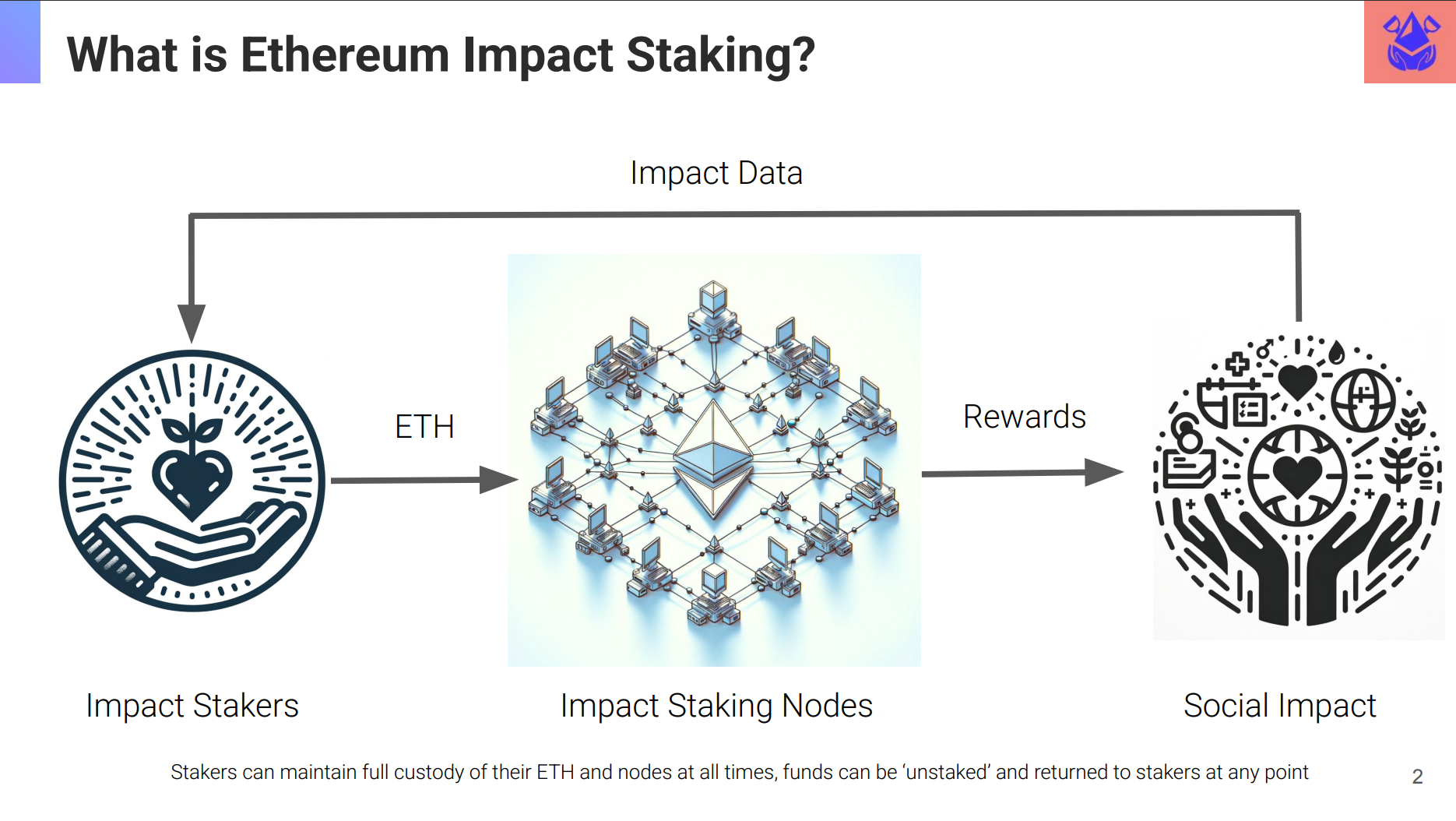
Participants learned how impact staking allows anyone to stake their Ethereum (ETH) securely, donate a percentage of staking rewards to UNICEF or other social-impact programmes, and withdraw their principal anytime. The approach offers a low-risk entry point into blockchain while contributing to causes for children and communities worldwide.
Reasons to Consider This
Start or stop anytime – Stake ETH through a transparent, audited smart-contract mechanism; your principal always remains yours.
Earn while giving back – You can donate anywhere from 1% to 100% of your staking rewards to support UNICEF’s innovation work or other verified impact projects.
Accessible and safe – Designed for both beginners and experienced users. It can be as easy as purchasing ETH with a bank payment (through a regulated exchange) and connecting a simple secure wallet such as Metamask to the platform.
Why It Matters
Impact staking represents a new “give-back modality” for Venture Fund alumni pledge community members alongside financial, in-kind, and advocacy contributions. It demonstrates how decentralized finance tools can mobilize new resources for social innovation while maintaining transparency and user control.
Q&A
Q1. What is impact staking and how does it work? Impact staking allows you to stake your Ethereum (ETH) to help secure the blockchain network and earn rewards — while donating a percentage of those rewards to social-impact causes such as UNICEF’s innovation programmes. Your principal remains fully yours: you can start or stop anytime, adjust how much of your staking rewards you wish to donate, and withdraw your ETH whenever you like.
Q2. How is this different from traditional donations? Traditional donations require transferring funds permanently. With impact staking, you’re not giving away your capital, only the yield it generates. For example, if you stake 1 ETH and decide to donate 50% of your staking rewards, you keep your 1 ETH and the other 50% of the rewards — while UNICEF receives the remainder.
Q3. What do I need to get started? You’ll need:
A crypto wallet, such as MetaMask;
Ethereum (ETH) or staked ETH (stETH), which can be purchased on regulated exchanges (Coinbase, Binance, etc.);
Access to the UNICEF Venture Fund impact-staking page on Launchnodes.
Once your wallet is connected, you can choose how much to stake and what percentage of your yield you want to donate.
Q4. How secure is the staking process? The mechanism runs on Ethereum’s native proof-of-stake protocol and uses audited smart contracts via Lido, one of the most widely trusted and decentralized staking infrastructure providers. Smart contracts are permissionless, meaning they execute automatically on the blockchain without intermediaries. This ensures transparency, consistency, and security — though no system is entirely risk-free.
Q5. How safe is it from scams or hacks? Launchnodes’ platform relies on battle-tested open-source contracts that have been audited. Because staking operates as part of Ethereum’s base layer, not an external add-on, it’s as secure as the network itself. While code risk exists in any blockchain system, Launchnodes uses industry best practices and ongoing audits to manage vulnerabilities.
Q6. What happens if the price of ETH drops? Can I lose money? Your staked ETH balance never decreases — you’ll always be able to withdraw the same amount you deposited. However, the market value of ETH can go up or down. For instance, if ETH’s price falls 20%, the fiat (USD or EUR) value of your holdings drops accordingly. To address this, Launchnodes is developing a stablecoin-based version using tokens such as USDC, USDT, or DAI via Aave. This allows participants to generate yield for impact donations while keeping their principal in stable-value assets.
Q7. What if I don’t have much blockchain experience? You don’t need to be a crypto expert. Most users today purchase ETH through a regulated exchange and link their wallet to the platform. The Launchnodes interface is simple and guided, making staking accessible even for first-time users.
Q8. How can donors or institutions track impact beyond financial transparency? Launchnodes already provides a Social Impact Marketplace where donors can view which organizations are receiving staking rewards and what outcomes are being achieved — such as the number of schools connected (through Giga) or trees planted (through Treedom). UNICEF Ventures is also developing on-chain verification systems for programme data, including project milestones and attested impact reports. A separate initiative, UNICEF Impact Credits, aims to record and certify verified outcomes on-chain, creating a transparent impact-tracking ecosystem.
Q9. How does permissionless technology help ensure sustainability? “Permissionless” means that once smart contracts are deployed to the blockchain, they run autonomously without requiring a central administrator. This adds resilience and longevity — even if a service provider ceases operations, the contracts continue functioning. It ensures that the impact-staking mechanism can operate for the long term, as part of Ethereum’s decentralized infrastructure.
Q10. Can this model be replicated by other organizations? Yes. Any organization can set up its own dedicated impact-staking page through Launchnodes. The model is open, transparent, and replicable, enabling other non-profits or social enterprises to fundraise sustainably using staking returns.
Q11. What if crypto is restricted in my country? In some countries, holding or transacting in crypto is not permitted. Alumni or donors based there can still participate by engaging partners or individuals in jurisdictions where crypto use is legal. They can stake and donate on your behalf.
Q12. Are there examples of impact staking in action? Yes. For instance, EdTech alumnus eKitabu uses solo impact staking to fund the development of accessible learning tools for children who are blind or visually impaired in Kenya. This demonstrates how blockchain mechanisms can translate directly into real-world social outcomes.
Q13. Who are the partners behind this initiative?
Launchnodes – Developer of the impact-staking platform.
Lido – Ethereum staking infrastructure provider.
UNICEF Office of Innovation / Giga – Programme and impact partners.
GSR Foundation – Advisory partner providing compliance and risk-management guidance.
Q14. What’s next for impact staking with UNICEF? UNICEF and Launchnodes plan to expand the model by:
Launching a stablecoin impact-staking pool to mitigate volatility;
Strengthening impact-data integration and blockchain verification;
Exploring how institutional donors can use staking as a sustainable resource-mobilization tool.